CLOSING TIME

This version of Beer, Beats & Bites is no longer active. The active version of the blog is located at http://www.beerbeatsbites.com. Please visit that address for the latest content.
Showing posts with label lager. Show all posts

Friday, July 20, 2007

More Weeks, More Beers

Geez, I keep forgetting to make a post about these! Here are the last few "Beer of the Week" posts I've made to Taste T.O.:

Waterloo Wheat - "...seems like a hybrid of a Belgian witbier and a German weissbier: it has the citrus and spice notes expected from a wit, but also a bit of the banana and yeast that’s typical of a weisse..." (full review)

Christoffel Blond - "...a somewhat unique version of a Pilsner, at least in comparison to the ones that most people are familiar with..." (full review)

Southern Tier Phin & Matts Extraordinary Ale - "...the pungent, grapefruit-like aroma of the Cascade hops [...] makes it obvious that this beer has some balls..." (full review)

Castlemaine XXXX Export Gold - "...aside from homesick Australians with bad taste in beer, I can’t imagine anyone enjoying this chunder from Down Under..." (full review)

Hacker-Pschorr Hefeweisse - "...a fantastic beer from a venerable brewery..." (full review)

Thursday, June 14, 2007

Beer(s) of the Week(s)

As promised a couple of weeks ago, I'm going to post teasers here for beer articles I'm writing for Taste T.O. and other sites such as Gremolata. The most regularly appearing of these will be my Beer of the Week column for Taste T.O., and here are the last couple of those...

Mill Street Cherry Beer

While I’m usually inclined to reach for a nice dry Pilsner or a hoppy Pale Ale when the weather gets warmer, I can understand the increased popularity of fruit beers in the summer months. Their fresh and lively flavours are a reminder of the warm weather harvest, and the often complex combination of sweetness and tartness that is found in many better quality fruit beers can be quite refreshing on a hot day.

So it makes sense that the folks at Mill Street would choose to make a cherry beer as the first summer seasonal at their brewpub. (Although I suppose the fact that they had a raspberry beer available during the early spring sort of ruins the "summer = fruit beer" angle I’m playing up here, doesn’t it? Damn.)

Click through to read the rest of this article

Gubernija Grand 9.5

When most people read the words “Malt Liquor”, the image that likely pops into their heads is homies in South Central drinking 40s of St. Ides, or perhaps the neighbourhood drunk slumped in an alley with a king can of Schlitz Red Bull spilled beside him. Either way, the beers that tend to be tagged as malt liquor aren’t exactly considered to be beverages of the highest quality.

Of course, the definition of “malt liquor” can vary depending on where you live. In some jurisdictions, any beer above a certain alcohol percentage must be labelled as “malt liquor” before being sold, meaning that everything from cheap, high-octane swill to elegant strong Belgian ales are considered to be in the same category in the eyes of the alcohol overlords.

As a beer style, however, malt liquor is generally understood to be a strong (usually 6% to 9% abv) lager that is most often brewed with the addition of non-barley adjuncts such as corn and sugar, and a very low hop content. The result is a sweet brew with very little bitterness and a strong alcoholic punch. The flavour and aroma are often unpleasant, with notes of everything from rotting vegetables to jet fuel, but such concerns are secondary in a beer that is simply intended to get the imbiber as drunk as possible, as quickly as possible.

Click through to read the rest of this article

Saturday, February 17, 2007

Five From Half Pints

Last fall, I got word of a new brewery starting up out in Winnipeg called Half Pints Brewing. Initially, I didn't pay much attention to the announcement. I mean, it's always good to hear about a new micro starting up, especially in Canada. But since the odds of ever seeing Half Pints beers available in Ontario are next to none, my reaction was basically "oh, that's nice, maybe I'll try some of their stuff if I ever make it out to Winnipeg".

But then I learned that the president and brewmaster of Half Pints was David Rudge, a man who is semi-legendary amongst Canadian craft brew fans. Mind you, most of us had never actually tried any of his beers, but we'd heard fantastic things about the stuff he did at Bushwakker Brewpub in Regina, Saskatchewan from those who were lucky enough to visit the pub. So I knew that I needed to get my hands on some bottles of his Half Pints offerings.

Luckily, I was able to find someone from Winnipeg on RateBeer who was willing to do a trade, and back in December, I got a nice big box packed with a bomber each of five Half Pints beers along with a few other goodies. I've made a point of sharing them at several different tastings and get-togethers over the last couple of months, and now that I've finally tried 'em all, here's what I thought:

Bulldog Amber Ale
Orange-amber colour with a small white head. The aroma holds some very nice woody hops, well balanced by some slightly grainy malt. Body is a bit light, but OK for the style. Once in the mouth, it proves to be a nice, simple, clean, balanced UK style ale with a well-hopped finish. A fantastic session ale - if the LCBO carried this (hint, hint!), it would be a regular in my fridge.

Little Scrapper IPA
Maybe all of the Double IPAs I've drunk have caused me to build up some hop resistance, 'cause I didn't find this nearly as hoppy as the description on the label promised. Oh, no doubt that there was a healthy amount in there - some great notes of orange rind and pine resin in both the aroma and flavour proved that - but I actually found it to be quite well balanced. Another one that I could drink a lot of if given the chance.

Oktoberfest Lager
I've generally found Oktoberfest beers to be pretty boring, but after having this, I think it's because most of the ones I've tried have just been mediocre beers, regardless of the style. It has a slightly hazy copper-amber colour with a medium head, and a quite malty aroma with sweet caramel and some interesting earthy/leafy notes. The flavour starts quite sweet, develops some bready notes in the middle, and finishes fairly dry with a hint of cocoa.

Stir Stick Stout
A coffee stout made with Ethiopian Yirgacheffe?!? Dude, I am SO there! Very dark brown colour with ruby hints and a couple of fingers of off-white foam. Nice aroma - very roasty with a good hit of coffee, some light woodiness and a bit of chocolate. This body is thin, which is the beer’s one main weakness. Thankfully, the flavour makes up for it - good roasted malt and coffee notes off the top, sweet in the middle, and a well bittered finish. With a bit more body, this would be a fantastic stout. As it stands, it’s just a very good one.

Sweet Nikki Brown
Brown ales are a much maligned style - somewhat deservedly, as most of them are boring as hell. But when they're done well, they're a real treat. This particular example pours a dark ruby-brown with a good sized mocha head. The aroma is great, with lots of sweet roasted malt, cereal (specifically, Honeycomb cereal), and herbal hops, all well-balanced. The flavour is roasty and nutty off the top, with a slightly watery middle, but a nice bitterness in the finish that makes up for it.

So, a big thumbs up on this first quintet from Half Pints. I have a standing order in with my new trading buddy for any of
David's future releases, and there are already four more waiting to be shipped - a winter seasonal Burly Wine, and the "Holy Trinity" series of The Father, The Son and The Holy Spirit - plus a couple more planned for the next few months. I expect you'll see another Half Pints post here soon enough.

Friday, September 08, 2006

¡Viva Vienna!

Like wine, many classic beer styles - especially those from Europe - are named after the area where they were first produced. Pilsner was born in Pilsen, Czech Republic; Kölsch in Köln, Germany; Dortmunder in Dortmund, Germany; and Vienna Lager in... well, that one should be pretty obvious.

But unlike the others, Vienna Lager had a pretty short history of being brewed in its hometown. It was first brewed sometime around 1840 by Viennese brewmaster Anton Dreher, who found that the city's soft water allowed him to use lighter malts in his beer, lending it a mellow amber colour that was unique for the time. His methods and recipes ending up being borrowed and refined by brewers in Bohemia (now part of the Czech Republic), leading to the creation of Pilsner, which in turn led to the creation of pretty much every pale lager beer in existence today.

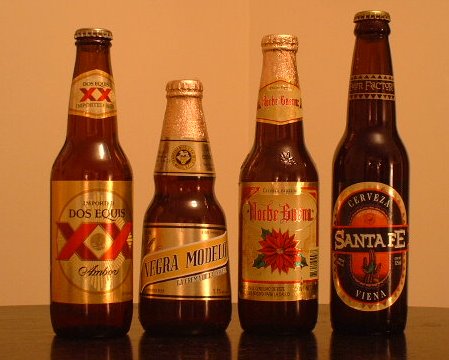
Despite the popularity of the beers that the style spawned, the original Vienna style dwindled in popularity by the late 19th century, and probably would've died off completely were it not for its revival at the hands of a group of Austrians who had emigrated to Mexico. Even today, the most popular examples of the style - Dos Equis Amber and Negra Modelo - are Mexican, and while more and more North American microbreweries are crafting their own versions of this crisp and malty lager (including Ontario's Ste. Andre), it's rare to find a Vienna that is actually brewed in Vienna - or anywhere else in Europe, for that matter.

I recently met up with a fellow RateBeerian who had a weekend stopover in Toronto on his way from Mexico to Scotland where he goes to school, and he was kind enough to bring me a couple of beers from his home country that happened to be Viennas: Noche Buena from the large national brewery Cuauhtémoc Moctezuma/FEMSA (also the producer of Sol and Tecate), and Santa Fé from the Beer Factory brewpub chain. I thought it would be interesting to sample them alongside the aforementioned Dos Equis Amber (Cuauhtémoc Moctezuma/FEMSA) and Negra Modelo (Grupo Modelo), so I brought them all along to a tasting with my usual crew the other night, and here's what we thought...

Dos Equis Amber
This one is almost as ubiquitous as Corona and Sol at most Mexican restaurants, so we all knew what to expect. It has a light caramel-amber colour with a small white head. The aroma holds sugary malt with some stale vegetal and cardboard notes - not very appealing. The body is watery, and the flavour is mild, tasting mainly of light caramel & sugar. Bland and inoffensive, just like a mass produced beer should be.

Negra Modelo
This beer is new to Ontario, but I first tried it when visiting San Diego last fall. It pours a dark, clear ruby-brown colour with a small tan head. The aroma is a bit stale, but still nice, with inviting malt and cocoa notes. The flavour is quite sweet, but also a bit roasty, with more hints of cocoa and a bit of caramel. Thin body, but it's otherwise more enjoyable than I expected, and certainly a step up from Dos Equis.

Noche Buena
This is a Christmas beer from the same mega-brewer that produces Dos Equis. It has a higher alcohol percentage than its more mainstream cousin (6% vs. 4.7%), and a slightly darker colour as well. The aroma has the expected sweet malt notes, along with an interesting herbal edge. The flavour starts quite sweet as well, but has a quickly appearing herbal bitterness, followed by a very short finish. Not bad, but the finish in particular is disappointing.

Santa Fé
Mexico is a country that is not exactly known as having much of a micro/craft beer culture, but the Beer Factory brewpub chain is one of a few brewers who seem to be trying to change that. Based on their take on the Vienna style, it appears that they're at least doing a better job at making beer than Mexico's big two. Santa Fé has a clear, dark amber colour with a small off-white head. The aroma isn't as sweet as the macros, but still has good hints of caramel and malt, with a faint smokiness as well. The flavour is very clean and fresh, with some bready malt and herbal hops. Simple, but enjoyable, and the unanimous favourite of the quartet.

Thursday, August 10, 2006

Lech Premium

Since it is a government agency, the Liquor Control Board of Ontario - a.k.a. the province's alcohol retail & wholesale overlords - has to be as politically correct as possible when it comes to selecting what products will appear on the shelves. It's therefore quite easy to correlate Ontario's immigration patterns with the LCBO's stocking patterns.

For example, I live in an area of Toronto that is quite close to a neighbourhood full of Polish shops and restaurants. As a result, my local outlet always has plenty of Polish brews on hand, including Tyskie, Okocim Lager and Strong (although sadly, they no longer carry the fantastic Okocim Porter), Zywiec Lager, EB Premium, Lezajsk Lager, Warka Strong, and Dojlidy Zubr.

The newest addition to this line-up of generally middling Polish imports is Lech Premium, which has the distinction of being the first of the bunch to be offered in cans (more evidence of the LCBO's somewhat questionable new policy to give preference to cans over bottles when selecting new beers for their general list - a topic for a future blog post, perhaps...). Like Dojlidy Zubr and Tyskie, Lech comes to us from Kompania Piwowarska, the Polish arm of SABMiller that stirred up controversy a while back when it took on some of the brewing of Pilsner Urquell, the classic Czech beer that defined the Pilsner style. But that's just the sort of thing that happens when multinational brewing behemoths keep chomping up the little guys...

Anyway... even though it's produced by an evil conglomerate, this Lech Premium is a decent little beer. It pours a pale, bright yellow-gold with large white head that disappears pretty quickly. The aroma holds soft herbal hops and a bready maltiness - quite nice. The flavour is fairly sweet off the top, with lemon cookie notes in the middle, and a good balance of herbal, grassy hops and biscuity malt in the finish. This will be a good option in the future when I'm in the mood for something light and refreshing, especially since cans tend to keep beers like this in better shape than bottles.